
By now at Cary-Grove, there is no doubt that you have heard of investing.
With clubs such as Invest CG and many popular business classes, such as Introduction to Business and AP Economics, there are many students who know what to do with their money and how it flows to and from many different people’s hands.
However, some people still do not want to do this because of many ethical debates.
- Is buying a defense stock in peacetime and selling it during a conflict profiting off of war?
- Is investing in technologies that may take away people’s jobs okay?
- Is getting rich while others lose lots of money okay?
These are some of the ethical debates people may face when deciding if they want to invest.
Despite these concerns, there are a multitude of ways to both profit and make a positive impact on society and the world, and my favorite way is thematic investing.
Thematic investing is best put as investing in a company or group of companies (which can be done by yourself or by buying mutual funds or exchange traded funds (ETFs)) that follow a specific theme.
These can include investing in specific companies that help produce clean (green) energy, a specific industry (or corner) of an index (like tech sector of the S&P 500, NASDAQ, RUSSEL 2000, etc.), investing in a specific country’s market (like an index fund of the FTSE in London or the DAX P. in Germany), your own political beliefs, potential market disruptors, and many more.
Because of the vastness of this field, I am only going to note a few themes that are available in the US: industry, foreign markets, and political thematic investing.
Along with each of these, there will be notes of a few example ETFs that are supportive of each of these.
Note: This is not financial advice – get yours from a trusted financial advisor.
Industry (Sectoral) Thematic Investing: Pros and Cons.
Pros and Cons:
- Concentrated into one specific corner of an index: more concentrated growth
- High Risk-High Reward: Performance is closely tied with the performance of sector
- Ex: Tech ETFs (including $VGT and $XLK) have (up until very recently) outperformed the total stock market, but have declined very quickly, showing the potential for fast exponential growth and decay that can happen with these.
- Success also highly depends on when you buy in: if you buy in at the peak, you may not get as much return as if you buy in during a time of economic correction.
Foreign Market Thematic Investing
Pros and Cons:
- Diversification of your assets: If for example, your domestic market is not doing so well for the time being, the foreign market may be still unaffected and making you money, reducing the risk.
- More exposure to higher growth (more so for developing countries’ markets): Emerging markets may be able to accrue higher growth than a developed market, because of its new upcoming industry and place in the global economy.
- Exposure to higher risk: Along with the higher growth, also comes higher rates of decay, as developing nations often experience periods of exponential growth and, if anything were to happen to it, exponential decay. This is highly related to the country in question’s local politics and geopolitics, as tensions are often between many peripheral countries.
- Currency and local governing advantages: Developing countries often have currencies that are weaker to developed countries’ currencies, such as the Euro, US Dollar, Swiss Franc, and GB Pound Sterling. Because of this advantage and often other economic incentives, such as tax breaks or citizenship for investors (in that country), it is cheaper, easier, and more meaningful to take that risk of investing in that certain country. NOTE: Currency fluctuations, caused by many events, can also affect your money vastly.
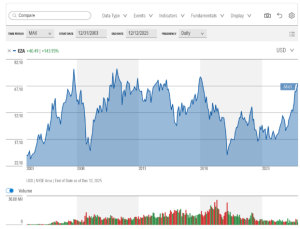 Ex: $EZA is an ETF of a mixture of companies that are based in the Republic of South Africa. If you look at the extended graph of $EZA, you can see price fluctuations over the years; you can see that when the gold price was lower between late 2023 and early 2025, the price of the ETF was significantly lowered, as it consists of many mining companies. Graph taken Dec 13, 2025 from EZA – iShares MSCI South Africa ETF | Morningstar.
Political Thematic Investing
Pros and Cons:
- They capitalize on specific politicians or political parties being in power, with the belief being that they will make certain policy changes that will improve and further increase a certain sector or specific stock’s price. HIGH RISK-HIGH REWARD.
- Ex: If a certain bill passes in Congress that allows further government investment into green energy for a more sustainable future, the energy sector may benefit, with the companies focusing on green energy benefiting the most.
- At the same time, if the politician does not do this or something else happens, there is no point investing in it, as you may make no real returns.
- Early investment into potential future policy shifts.
- If these policy shifts stick, it has the potential to outperform the total market.
- Predicting when and if these policy shifts will stick is notoriously difficult.
- You can further promote your political values to the world.
There are different ETFs to achieve this goal. For example, there are funds that track the specific securities purchases of specific politicians (like $NANC or $GOP) or meet specifications that certain political parties desire (like $MAGA). 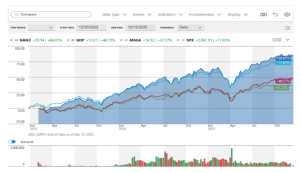
Graph taken on Dec 14, 2025 from NANC – Unusual Whales Subversive Dem Trd ETF | Morningstar.
However, these are often regarded by many (including myself) as basic alternatives to meme-stocks. This investment driver specifically is not recommended for the vast majority of people, as recently, very few have performed well or outperformed the market, and the ones that contain companies have proven themselves to be (regardless of political affiliation) to be constant drivers of change and innovation in the world.
Conclusion
Thematic Investing is a vast field that contains many types of securities. There are ones that are known to be extremely popular and profitable because of their field, sector, and cause; there are also many that are known to be ultra high risk, with little chance of high returns, only made to make a statement. Hopefully, based on this article, you have gotten a basic understanding of thematic investing and three popular (and sometimes controversial) ways of taking part in it.
However, at the end of the day, the consumer is the one who has to make the decision if they want to do it. After all, capitalism is based on the free market, by the people, for the people, of the people.
Works Cited
Rao, Soumya. “Thematic vs. Sector Funds: Key Differences and Which is Better?” Bajaj Finserv Mutual Fund, 9 January 2025, https://www.bajajamc.com/knowledge-centre/thematic-vs-sector-funds. Accessed 13 December 2025.
“Why invest internationally?” Vanguard, https://investor.vanguard.com/investor-resources-education/understanding-investment-types/why-invest-internationally. Accessed 13 December 2025.